
A client recently asked us whether minimum separation distances are required between a flammable liquid store and a forklift battery charging station.
The short answer is yes, but the minimum separation distance will depend on the capacity and design of the store.
There is no explicit separation distance for a flammable liquid store versus a forklift charging station.
However, guidance does exist for separation distances between flammable liquid storage and fixed ignition sources. Battery charging stations fall into this category.
There are two main standards which cover this area:
- HSG-51: Storage of flammable liquids in containers
- HSG-176: Storage of flammable liquids in tanks
Flammable Liquid Separation Distances for Container Storage
HSG-51 provides a table of minimum separation distances for flammable liquids stored in containers. These distances apply to occupied buildings, site boundaries, process units, storage tanks, and ignition sources:
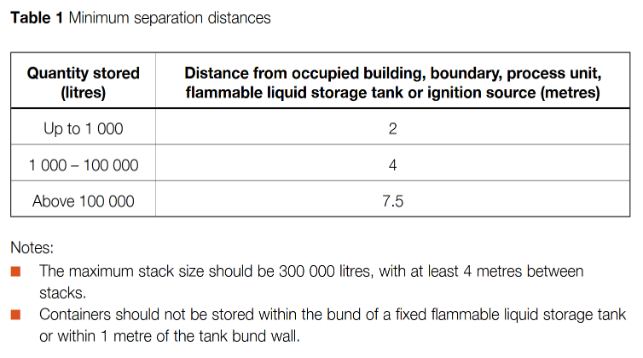
Clauses 157 and 159 allow reduced separation distances where additional protective measures are used. These include fire walls and monitoring or deluge systems. Clause 158 notes that you may require larger separation distances if a risk assessment highlights particular issues specific to the site which may indicate that the minimum separation distances in Table 1 are not adequate. For example, estimated long/slow response time of emergency services (e.g. remote, poorly accessible sites); limited availability of firewater supply; extent and nature of process plant; and proximity of vulnerable populations.
Separation distances also should be kept free of any combustible materials.
For Storage in Dedicated (Separate) Buildings: The same minimum separation distances from Table 1 of HSG-51 apply. These distances are measured from the outside wall of the building to other buildings, boundaries, tanks, or ignition sources. Where this is not achieved, the wall (or part of the wall within the separation distance) must be a fire wall. Any doors within the separation distance must provide at least 30 minutes fire resistance and be self-closing.
For Storage in Storerooms (within other buildings): the same minimum separation distances from Table 1 of HSG-51 apply. These distances apply to partitions including walls, ceilings, and floors. Where this is not achieved, the partition (or part within the separation distance) must be fire-resisting construction. It must provide at least 30 minutes fire resistance in integrity, insulation, and load-bearing where applicable. Doors within the separation distance must also provide at least 30 minutes fire resistance and be self-closing.
Flammable Liquid Separation Distances for Single Small Tanks
HSG-176 gives the following table of minimum separation distances between single ‘small’* tanks, from all: site boundaries, buildings, process areas, and fixed sources of ignition:
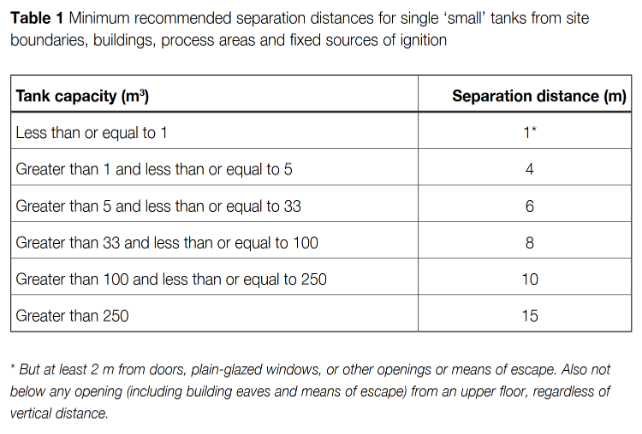
*HSG-176 defines a ‘small’ tank as any tank with a diameter < 10 m.
It also recommends a minimum of 2 m separation between groups of ‘small’ tanks for tanks greater than 100 m³ capacity.
Separation Distances for Groups of Small Tanks
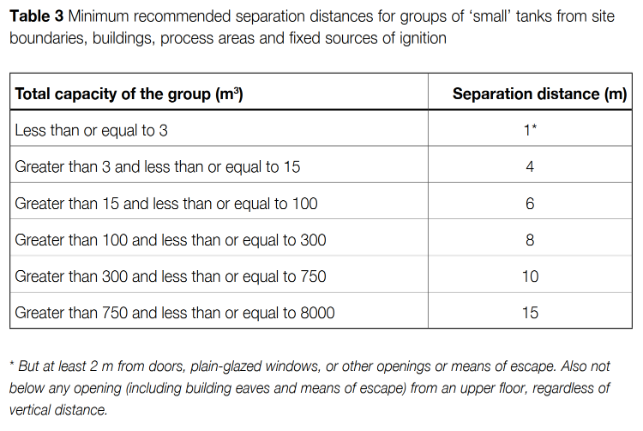
HSG-176 also gives the following table of minimum separation distances between groups of ‘small’ tanks, from all: site boundaries, buildings, process areas, and fixed sources of ignition:
Separation from Other Flammable Substances
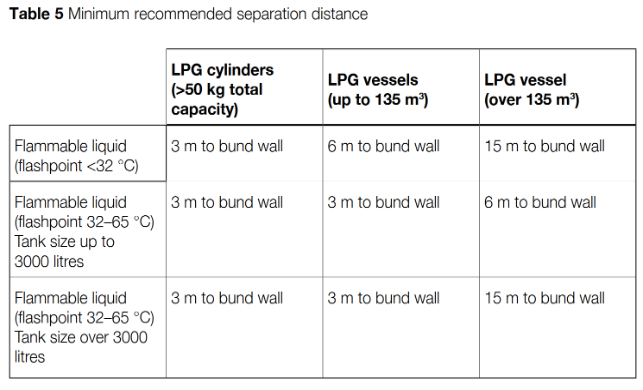
Table 5 of HSG-176 gives the following minimum separation distances of flammable liquids (it uses LPG as an example and states that you should use the greater of either these values, or values given in published guidance for the specific flammable substance in question, if such exists) stored in tanks, from other hazardous substances:
Bunding & Higher Flashpoint Liquids
Clause 161 states that minimum recommended separation distances between the tank and bund wall are 1 m for tanks up to 100 m³ and 2 m for tanks above 100 m³. Regarding ‘higher flashpoint liquids’ (which are defined in HSG-176 as liquids which will always be at least 10 °C below their flashpoint, even at the highest operational temperature), clause 285 states:
The recommended minimum separation distances for a tank containing higher flashpoint liquid are:
- from another tank containing a higher flashpoint liquid: the minimum needed for safe construction and operation;
- from a tank containing a low flashpoint liquid: in accordance with Table 2 [i.e. 2 m separation, for tanks greater than 100 m³ capacity].
For ‘higher flashpoint liquids’ (see definition above), clause 287 states: The separation distance from buildings etc may be reduced to 1 m.
References:
HSG-51: Storage of flammable liquids in containers (clauses 81-83, 152, 155-159, 181-183 & 197-206, and Table 1, and Figures 7-9) HSG-176: Storage of flammable liquids in tanks (clauses 83-88, 144, 161, 190, 202, 284-285, 287, 289, and Tables 1-5, and Figure 5)
If you have questions about flammable liquid storage, tank design, DSEAR compliance, or separation distances, our team can help assess your site against current guidance and industry good practice.
For further reading, see HSG51, HSG176, and relevant guidance published by the Health and Safety Executive.